
A Romantic Day and Sunset Night with drinks & dining & art in Rome: Galleria Borghese, Via Margutta, Villa Borghese Gardens, Spanish Steps
One of our favorite and most romantic things to do in Rome over the years was to stroll through the Villa Borghese parks and gardens to one of the most elegant and sensual villa art museums on earth: The Galleria Borghese. It is one of the most important art museums in the world, and its world renowned art collection is housed in such a pleasant series of gardens and parks, tucked away in a lovely palazzo.
The Renaissance and Baroque gardens of umbrella pines, cypresses, palm trees, flowers, hedges, and exquisite lemon, orange, and magnolia trees of the Villa Borghese parks surround the gorgeous Borghese Art Gallery, transporting visitors back into the past glories of Roman country estates. Fortunately for us, they are free and open to the public now for generations.
The parks were private gardens for the aristocrats of Roman society until they were opened for the 19th century Grand Tourists. In 1820 English Romantic poet John Keats himself strolled through these same hallowed grounds before he succumbed to tuberculosis in his rooms at the Piazza di Spagna. Goethe mused through the art collection of the Borghese’s a generation before that, recording his impressions of the palazzo and of the art in his grand book, Italian Journey.
The beautiful Galleria Borghese is home to part of the Borghese art collection curated by the Cardinal Scipione Borghese (nephew of Pope Paul V (reign 1605-1621).
The Villa was commissioned to be designed and built by the architect Flaminio Ponzi, partly based on sketches by Scipione, as a “villa suburbana” on the country edge of Rome. Scipione was one of the first patrons of Bernini and collected many pieces by Caravaggio, including The Sick Bacchus, Boy With a Basket of Fruit, and the poignant Saint Jerome Writing.
The Borghese collection also includes the breathtaking Bernini sculptures of David, Rape of Proserpine, and Apollo and Daphne, – and the Tiziano masterpiece, Sacred and Profane Love.
Other maestros are Raffaello “Lady With A Unicorn” (purported to be the Lady Giulia Farnese, commissioned by Pope Alexander aka Rodrigo Borgia), alongside countless pieces by Rubens, Barocci, Antonio Canova, Coreggio, Dosso Dossi, Domenichino, Veronese, Lorenzo Lotto, and Parmigianino.
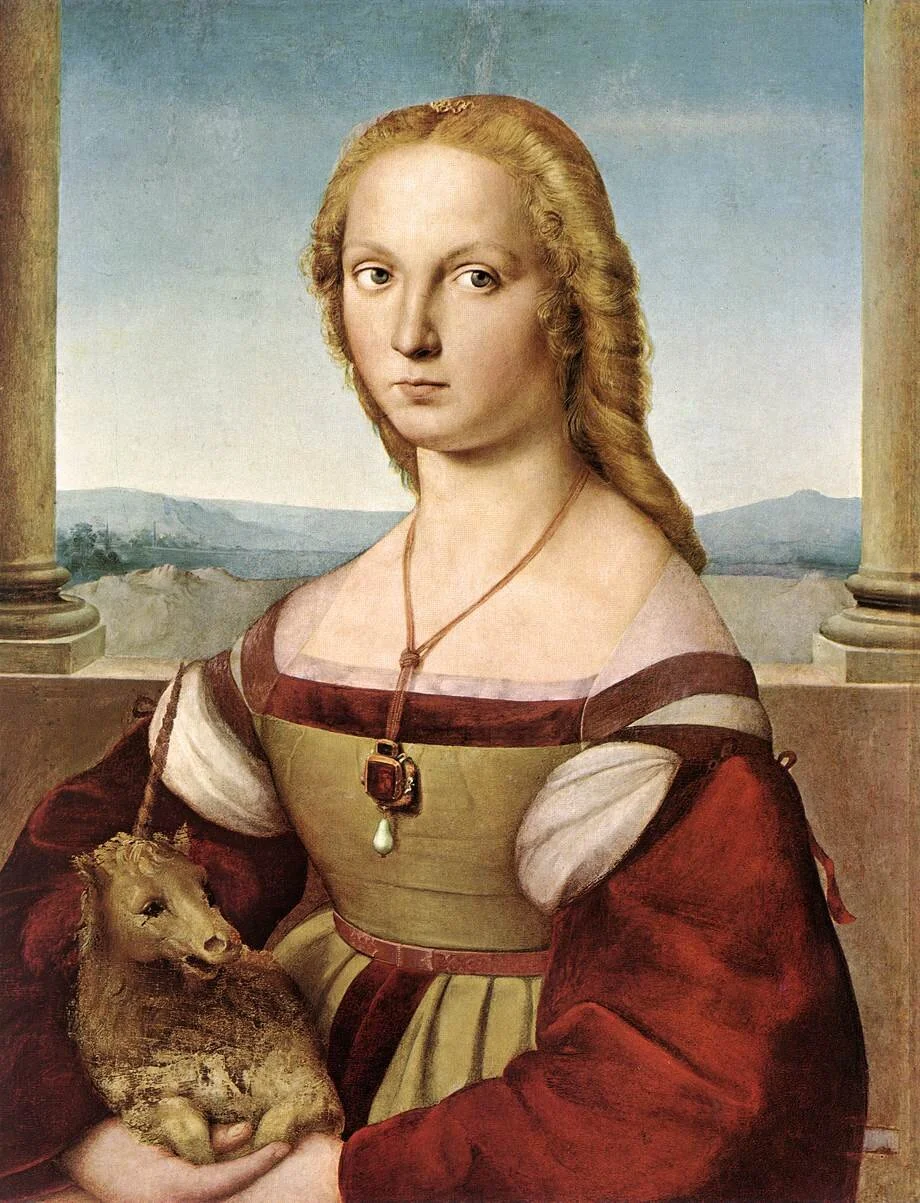
Portrait of Young Woman with Unicorn is a painting by Raphael.
I love the gorgeous architectural details in stone and in fountains and statues lining the entrance of the Galleria Borghese. Remnants of the past play out as well in ancienne statue fragments and the fountains outside the museum’s grand entrance. The walk to the Galleria Borghese always has that lazy Sunday feeling, surrounded by Roman families and visitors enjoying the greenery and fresh air. Young and old lovers can be spied kissing under a tree or lying on a picnic blanket enjoying the sunshine and the sounds of songbirds above them.
There are homages to temples, gods and goddesses, Greek Tragedies and Comedies, and to Rome’s storied past in the “Romantic era ruins” among the pleasure walks and dreamy Umbrella pines. As you approach the museum you feel you are in for something really special… and are not disappointed in the great architectural reveal.
More architectural details by Flaminio Ponzi and Scipione Borghese create a feast for the eyes, before entering the villa with a ticket… for the Roman antiquities and Renaissance and Baroque masterpieces, … in room after sumptuously decorated room.
Tickets are recommended bought IN ADVANCE, online or at the ticket office down the stairs. To enter the museum, proceed up the stone stairs to the stunning Classical Antiquity portico where they will take your ticket.
You don’t want to miss this experience!
After an afternoon stroll and a few hours in the museum, head to the Pincio at the Golden Hour (an hour before dusk) and watch the sun set over the cupolas and ruins and houses behind the glittering Piazza del Popolo.
The golden and orange light eventually turns a deep violet, and there is an enchanting glow about Rome at its most magnificent! It is a heady, Romantic vision, and every one seems to be under a collective spell of beauty and the feeling of immortality in Éros in the Eternal City.
This is one of the best, most beautiful, and unforgettable days you could spend in Rome. It could be the most romantic Valentine’s Day of your lives. Rome seen and felt like this is truly writ on the heart for an eternity.
You can eat at the romantic nearby Casina Valadier for sweeping sunset views and aperitivos or an early dinner – they have a Valentine’s Day prix fixe menu for lovebirds.
Looking for something quicker? Walk a short distance to the late Renaissance church of the Santissima Trinità dei Monti, (French: La Trinité-des-Monts).
Pop into the sanctity and quiet beauty of the French Roman Catholic church and you may luck out with a choir of nuns singing en français classical songs of devotion while you peer at lush murals, sculptures, paintings, and the altar.
Light a candle together and head down the famed Spanish Steps just outside and whisper a snippet of a Keats ode into your beloved’s ear outside of the Keats Shelley (Byron) House Museum (worth a visit if you’re there earlier when it is open!).
Stop for a late tea at Babington’s and try their Rome in Love Tea inspired by the Paolina Borghese sculpture and Female Beauty at the Borghese, or enjoy some cocktails or champagne and light fare – offered in the luxurious comfort of their 125 year old tea room. It’s a cute British afternoon tea room with Italian flare.
Looking for something sexier? Cross the avenue and stop in at the nearby Romantics’ saucy hangout, the Antico Caffè Greco, decorated in 18th century red satin and marble decor, for drinks and desserts.
Don’t skip a look and a ponder in the beautiful Santissima Trinità dei Monti French Church, at the top of the Spanish Steps from the Via Condotti.
Gregory Peck’s apartment in Roman Holiday where he brings Audrey Hepburn in the film is found in the romantic and quiet street of Via Margutta.
If you’re still in the mood for a short early evening walk hand in hand past the glamorous shops and passersby, head to the most romantic street in Rome, the charmingly low-lit, ivy covered boutiques and artisan art shops, boutique hotels, and restaurants, Via Margutta (made famous by Audrey Hepburn and Gregory Peck in Roman Holiday!) I love the vegetarian restaurant created by film director Federico Fellini, Il Margutta! They have many vegetable creations, handmade pasta and smoked cheeses, and a vegan and gluten free menu, with exceptional organic wines, mocktails, and delicious desserts, including house made gelato.
GALLERIA BORGHESE (english site)
https://galleriaborghese.beniculturali.it/en/visita/
Via del Collegio
Romano, 27
00186 Roma, Italia
tel. 39 06 67231
www.beniculturali.it
Antico Caffè Greco http://caffegreco.shop/index.php
Via dei Condotti, 86, 00187 Roma RM, Italy
Babington’s Tea Room https://www.babingtons.com/en
Piazza di Spagna, 23, 00187 Roma RM, Italy
Casino Valadier Restaurant https://casinavaladier.it/
La Grande Cucina S.p.A.
Piazza Bucarest, Villa Borghese
00187 Roma
P. I.V.A. 05901701002
Tel (+39) 06 69922090
Fax (+39) 06 6791280
info@casinavaladier.it
Il Margutta vegetarian food & art https://ilmargutta.bio/
Via Margutta, 118 – 00187 – Roma
Per informazioni e prenotazioni:
info@ilmargutta.bio
Tel : +39 06. 32650577
Fax : +39 06. 3218457


Posthumous John Keats
A John Keats Pilgrimage in the heart of Rome, Italy
This is the view John Keats had of the world for the last months of his life. Once he was too sick to climb the Spanish Steps to the Pincian Hill view of the sunset over the piazza delle popolo and take in the sweeping view of the renaissance rooftops of cupolas, churches, houses and hotels of Rome – he had one final view, the Bernini fountain outside his room, at the end of his deathbed. He could hear the passersby and the fruit sellers. He could hear the horses hooves and the coaches. He could hear the rushing water of the fountain and smell the scent of the sweetest water in Rome. Sometimes he could drink it, a few shallow sips in a brief moment of respite.
I stood and looked out his window and took this shot with my phone. I stood there for ages alone and stared out the window and looked for John Keat’s ghost or a shadow of his memory, an imprint of him somewhere. I think I found him in the golden glow of dusk which touched everything in Rome for the last hour before sunset and made everything so pretty it hurt to lose it each night.

John Keats’ Rome house is located at the Spanish Steps by the Bernini fountain. On one visit I placed a white rose I brought for John Keats’ Plaque near his grave on the wall to the left of the garden in the Testaccio neighborhood of Rome in the Non-Catholic Cemetery near the Pyramid of Cestius. We recited his poetry and pet cats who slumber in the gardens nearby. The annual pilgrimage to the Protestant Cemetery never fails to give me chills when I read the epithet Keats intended for himself; Here lies One Whose Name Was Writ In Water.
And now these words ache in my own heart for the one companion who always joined me on these sojourns: Rian, now gone into the shadows to blaze his own light in a place or time I cannot see nor touch for I am still rooted to the earth… and the two men who could ensorcell me are now words and memories without touch or sense or feeling. In vast darkness or light, I do not know, but their imprints are still felt in this world of the living. They capture me!
“Forlorn! the very word is like a bell. To toll me back from thee to my sole self! Adieu!”
Each time I followed the sign reading KEATS it felt like a mystery unfolding. No matter how many times I retraced my steps to the back garden, to the memory of him, it felt new again, as though taking holy orders in a hushed silence under a canopy of umbrella pines and sky and garden walls, nature’s cathedral summoning pilgrims with the tolling of a bell nearby echoing on the stone of the tombs and graves and statues.
One evening, alone, over a sparkling golden glass of prosecco at Caffe Greco, in Rome, Italy, in Oct 2012 on a bar napkin I penned these thoughts:
Tonight I looked for Keats’ ghost.
Spotted Byron in the Borghese and heard Shelley was somewhere around the Villa Medici. Caught a glimmer of him.
Goethe kept a respectful distance when I passed him on the Pincio.
Keats silently joined me eventually somewhere on Via delle Magnolie. He slipped out from the shadows and fell into step with me. I felt him quietly by my side for the rest of the night.


